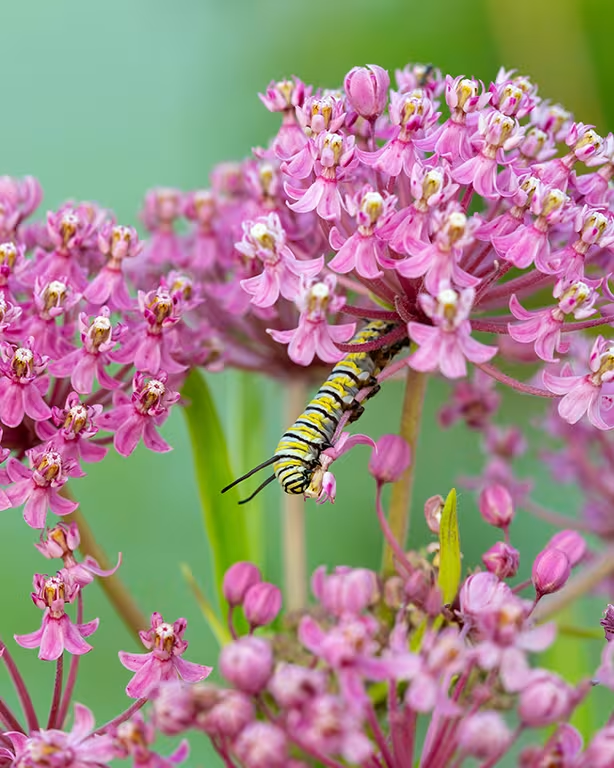
Everyone is invited to see the stunning photography of Dr. Ted Wilson, biology, currently on display throughout the hallway on the third floor of the Fine Arts Center until the end of the spring semester.
The exhibit, entitled “Through a Biologist’s Lens,” highlights the beauty of the natural world from Myrick Park and beyond.
An entomologist and ecologist with a lifelong fascination with insects and the natural world, Wilson has devoted much of his career to observing the details of nature. He shares that passion with the community through live arthropod demonstrations at elementary schools, earth fairs, and other public events. He is currently co-authoring a children’s book series featuring insects and is collaborating with an artist and community working group to develop an insect mural near the Children’s Museum of La Crosse in the city’s downtown.
“Photography has become another way for me to explore and share the natural world,” Wilson said. “Modern digital photography has given me a way to connect my scientific background with artistic expression. I am particularly drawn to color, geometric shapes and symmetry, landscapes, and living organisms, especially, of course, the hidden and intricate world of insects.”
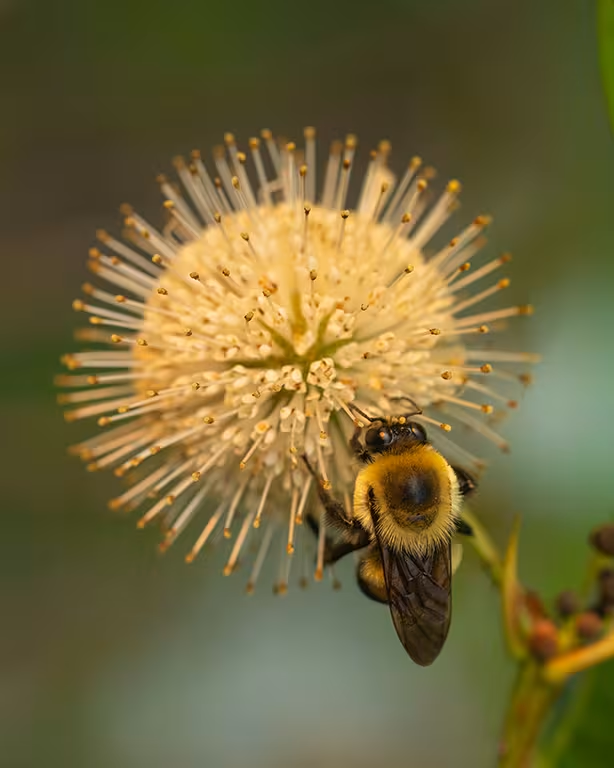
Wilson enjoys exploring a wide range of photographic styles, including macro, wide-angle, telephoto photography, and videography. He recently helped establish the Viterbo Student Photography Club.
Known for taking students out of the traditional classroom and into the rivers, forests, prairies, and marshes of the La Crosse area, Wilson teaches courses such as Conservation Biology, Limnology, Ecology and Evolution, and Environmental Science. He has also led multiple study-abroad experiences to the Galápagos Islands of Ecuador, Costa Rica, and Honduras. Some of Wilson’s student-mentored research projects have included studying the nesting behavior of solitary bees, using AI to identify frog calls, measuring the biodiversity of insect populations in local ecosystems, studying the food preferences of native pollinators, sampling microplastics in aquatic ecosystems, and sampling nocturnal insects using black lights.
Photos by Ted Wilson. Homepage photo: Male Ruby Throat Hummingbird.